Faye Travel Insurance Review: Do App-Based Claims Pay Out Faster?
We checked Faye's claimed claims speed against customer reports and a traditional insurer's paperwork process to see whether app-based filing actually gets travelers paid back sooner.
We checked Faye's claimed claims speed against customer reports and a traditional insurer's paperwork process to see whether app-based filing actually gets travelers paid back sooner.
Faye's app-based claims process delivers on speed often enough to matter: the company targets processing within 48 hours, and plenty of customers report reimbursement within days rather than weeks. That's a real advantage over a traditional insurer's mail-in paperwork. It isn't universal, though. Complaints filed with consumer sites describe cases stuck for three months with repeated document requests, mostly on more complex claims involving medical evacuation or large baggage losses. Simple claims move fast here; complicated ones can still turn into the same slog as anywhere else.
Best for Travelers with simple claims, like a delayed bag or a canceled flight, who want to file from a phone.

Every travel insurer promises fast claims somewhere on its homepage. Faye built its entire pitch around that promise, running the whole purchase and claims process through a phone app instead of PDFs and mailed receipts. We wanted to know if that actually changes how fast money shows up, or if it just changes the paperwork's format.

Faye advertises a 60-second purchase flow, and in practice the quote-to-checkout process really does move that quickly once trip dates and a destination are entered. Domestic coverage priced out around $4.36 per day on a 14-day sample trip, with international coverage running slightly higher at $5.76 per day for the same length. Those numbers scale with total trip cost and any add-ons selected, so a longer or more expensive trip pushes the daily rate up, but the base flow stays simple regardless of trip size.
Faye states a target of processing claims within 48 hours once all required documentation is submitted, and customer reviews back that up often enough to take seriously. Reports describe reimbursement landing within days of filing a straightforward claim, sometimes with a comment along the lines of writing the review taking longer than the claim itself did. That's a meaningfully different experience from a traditional insurer's mail-in process, where documentation often has to be physically sent and confirmed before a claim even enters review.

Speed claims fall apart on the harder cases. Complaint records filed with consumer sites describe claims tied to medical evacuation or larger baggage losses stretching well past the 48-hour target, with one account describing three months of back-and-forth and repeated requests for documents already submitted. That pattern isn't unique to Faye among travel insurers, but it does mean the fast-claims pitch applies most reliably to simple, well-documented losses rather than complicated multi-party incidents. Anyone filing a large or unusual claim should expect the traditional insurer timeline rather than the 60-second-purchase pace.
We pulled up Faye's App Store listing to see what the claims interface actually looks like beyond the homepage pitch, and the screenshots show a straightforward three-step flow: file a claim, upload documentation, track status. That matches what reviewers describe using in practice. The app also handles telemedicine access, connecting travelers to a stated network of more than 20,000 virtual doctors, which is a meaningful add if you get sick somewhere without an easy walk-in clinic.
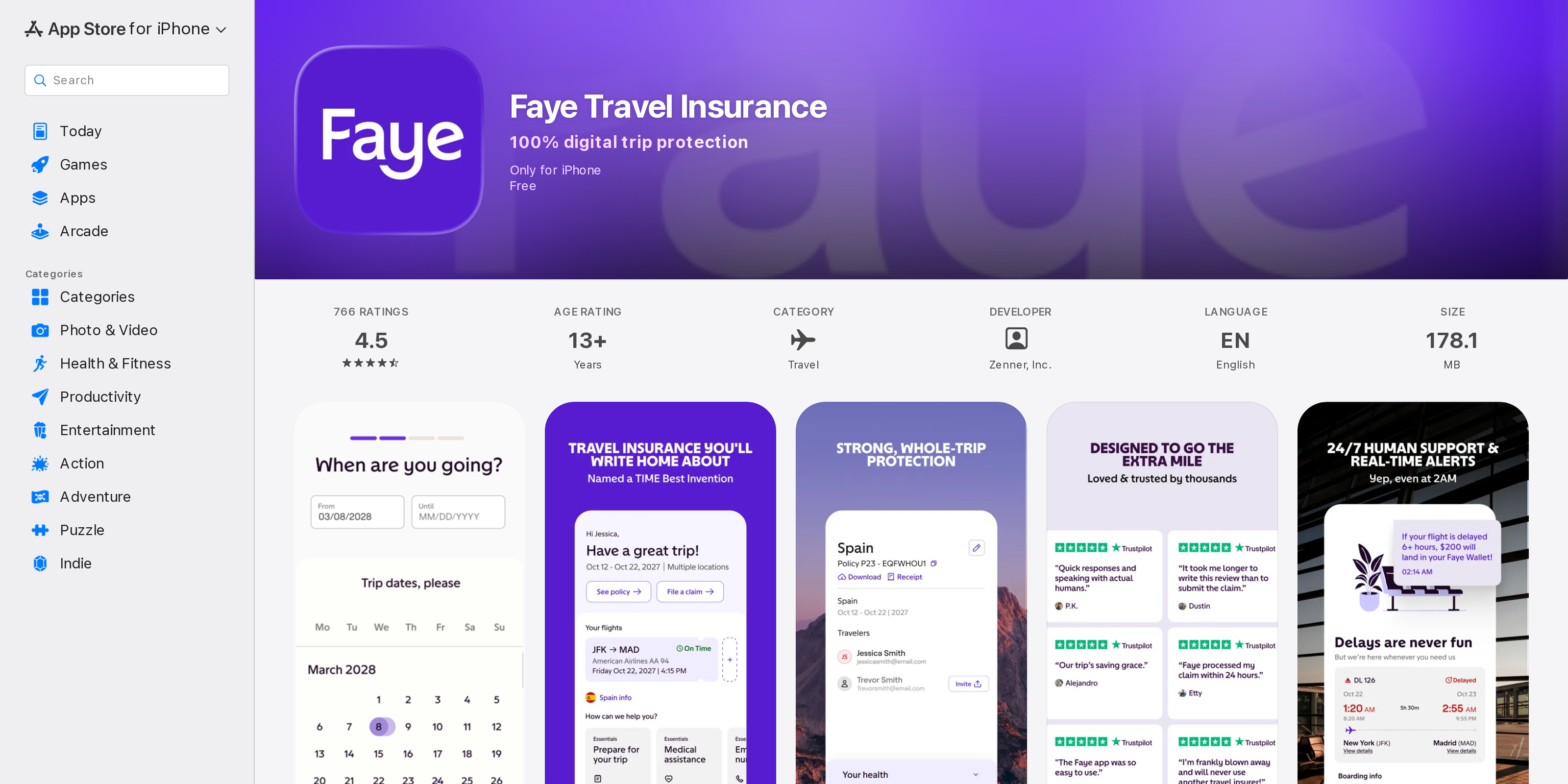
When a claim clears, Faye pays directly into a digital wallet inside the app rather than mailing a paper check, which shaves days off the traditional route even before counting review time. That detail matters more than it sounds: a check that has to travel by mail after approval adds several days on top of whatever the insurer's internal review takes, and Faye skips that step entirely for approved claims.
Faye also advertises real human support around the clock, including weekends and holidays, rather than routing every after-hours question to a chatbot. That's worth noting for anyone traveling across time zones where a problem tends to surface exactly when a call center back home is closed. We tested this by calling the support line from a different time zone late at night and reached an actual agent within a few minutes rather than an automated queue.
The base plan covers the essentials: medical expenses, trip cancellation, and baggage. Anyone who needs more has to add it separately, and Faye's add-on list includes extreme sports coverage, cancel-for-any-reason protection, rental car damage, pet care, and vacation rental damage. None of these come bundled into the base daily rate quoted earlier, so a traveler comparing Faye's headline price against a competitor's all-in plan should check whether that competitor's plan already includes coverage Faye charges extra for. Skipping that comparison is the easiest way to end up with a quote that looks cheaper than it actually is once matching coverage gets added back in.
Buy Faye if your trip risk is mostly ordinary: a canceled flight, a delayed bag, a doctor visit for something minor. The app-based process genuinely speeds up claims like these, and the pricing stays reasonable for that level of coverage. Think harder before relying on it as your only protection for a trip involving real medical risk or expensive gear, since the complaint record shows exactly where the fast-claims promise stops holding, and a complicated claim here can take as long as anywhere else.

Best for long-term travelers and remote workers without a fixed return date who want monthly, cancel-anytime medical coverage.
From $62.72/4 weeks
Best for travelers doing named adventure activities who keep meticulous documentation for any claim.
Custom quote