Anker 737 Power Bank Review: 24,000mAh Is Heavy, and Worth It
The Anker 737 packs 140W of laptop-charging power into 630 grams, right up against the airline watt-hour limit. We weighed whether that capacity earns its place in a carry-on for a week away from outlets.
By The Packroute Test Desk//Updated
7.8
out of 10
/10
Verdict: pack with caveats
At 630 grams, the Anker 737 is the heaviest thing most people will pack into a carry-on that isn't clothing, and 140W of output combined with a 24,000mAh, 86.4Wh capacity is exactly why it earns that weight. It charges a laptop and a phone at once, tops itself up in under an hour on a fast charger, and sits safely under the 100Wh airline ceiling that trips up bigger power banks. For a single phone on a weekend trip, it's overkill. For a week away from reliable outlets with a laptop in the bag, it's one of the few power banks worth the extra half-kilo.
Best for Travelers carrying a laptop who need to charge multiple devices from one outlet-free bank for several days.
A power bank that can charge a laptop sounds like a niche need until the second day of a trip with no outlet in sight. The Anker 737 exists for exactly that gap, and it fills it at a cost measured in grams as much as dollars.
The number that matters: 86.4Wh
StorageReview's independent teardown confirming the 737's 86.4Wh capacity
Airlines cap carry-on batteries at 100 watt-hours without special approval, and plenty of high-capacity power banks land dangerously close to that line or over it. The 737 comes in at 86.4Wh, confirmed independently by StorageReview's teardown of the same 24,000mAh cell, leaving real margin before a gate agent has a reason to ask questions. That margin is the whole premise of the product: Anker pushed capacity as high as it could go while staying comfortably inside the rule that actually governs whether this thing flies with you.
What 140W buys you
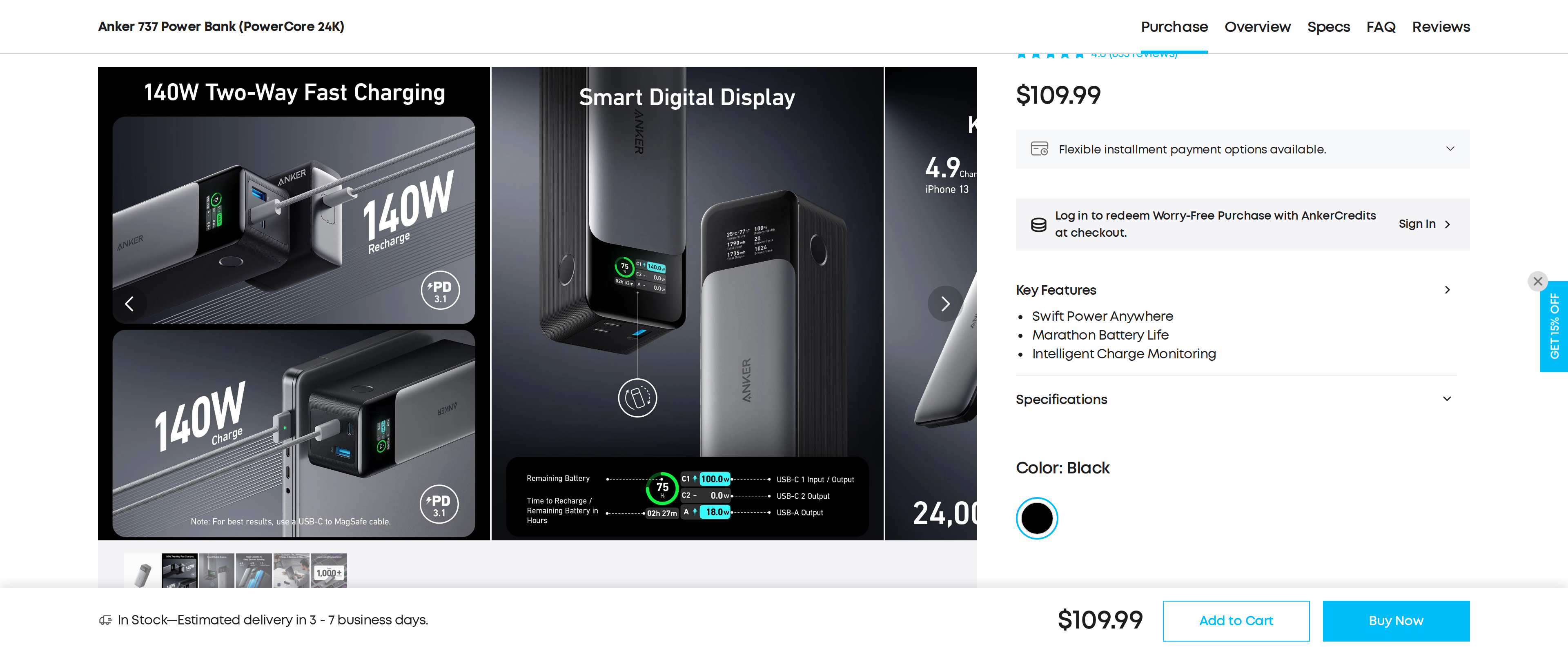
Most travel power banks top out around 20 to 30W, enough for a phone and not much else. The 737 pushes 140W combined across its ports, with each USB-C port capable of hitting that ceiling on its own.
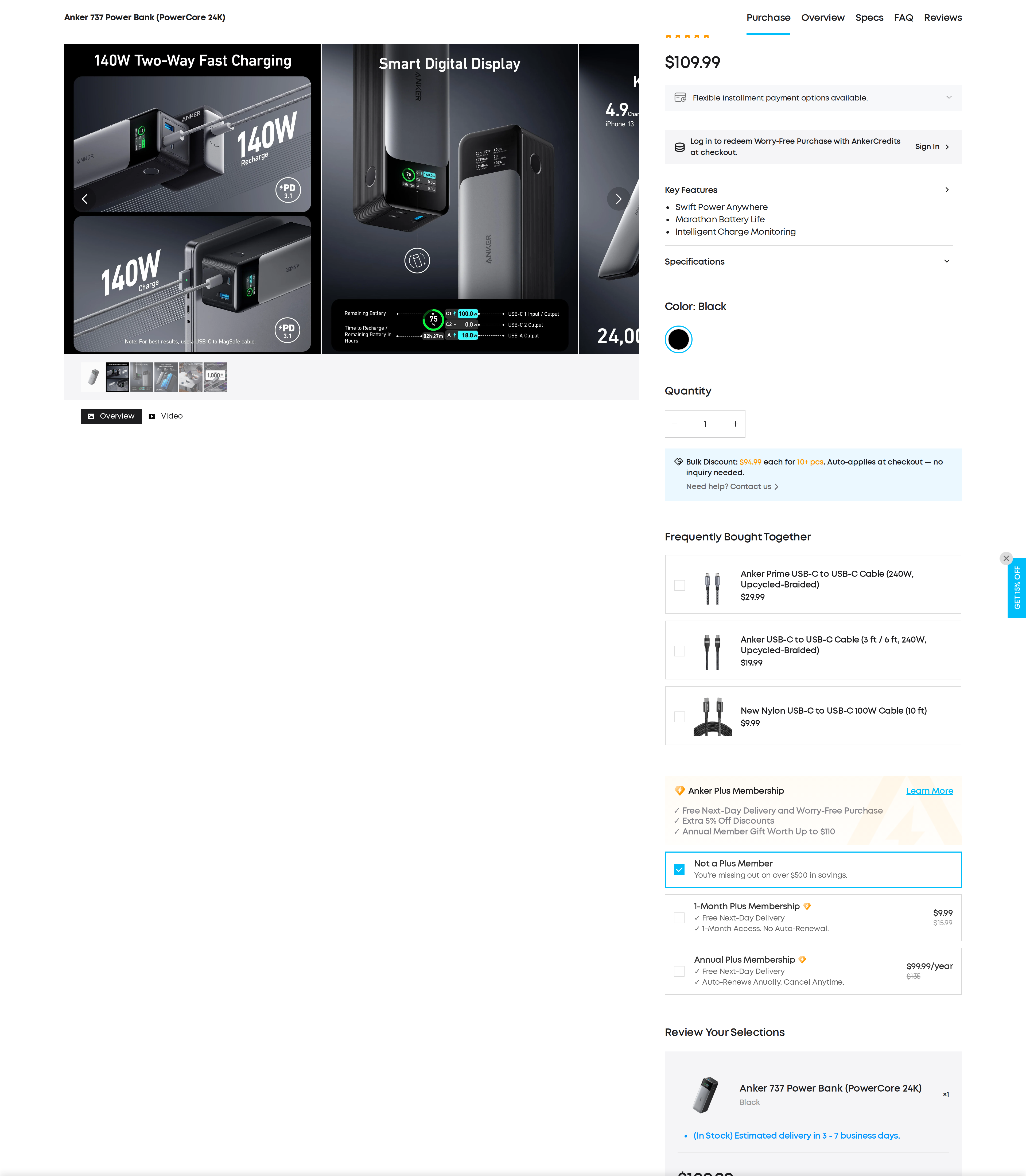
Anker's product page showing the 737 alongside its charging cable and case bundle
In practice that means a MacBook Pro and a phone can charge from the same bank simultaneously without either one crawling along at a reduced rate. Recharging the bank itself is just as fast: paired with a 140W charger, it refills in about 52 minutes, compared to roughly 90 minutes on a 100W charger. For a traveler who only has a short layover near an outlet, that speed difference is the gap between leaving with a full bank and leaving with three-quarters of one.
The USB-A port is the one compromise: capped at 18W, it's there for compatibility with older accessories rather than fast charging, and anyone relying on it as a primary port will notice the difference against the USB-C outputs.
Living with the weight
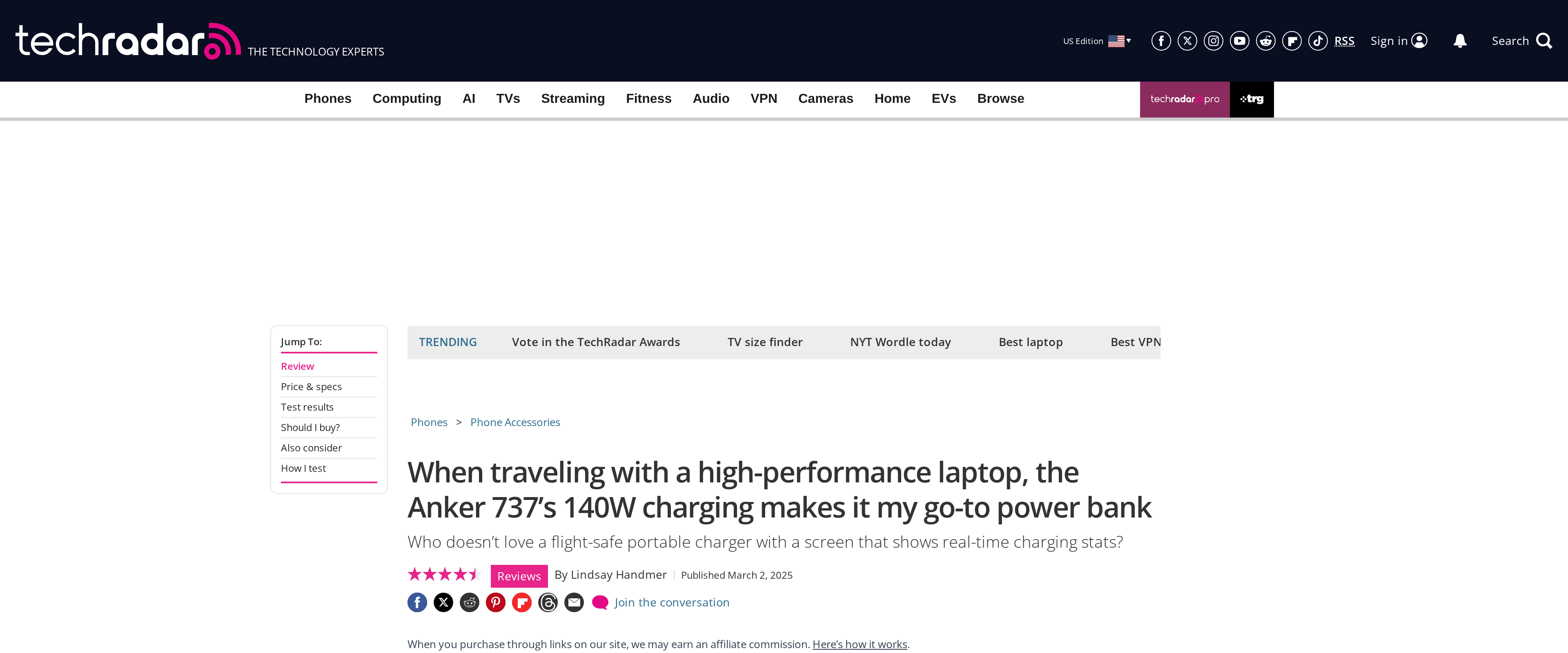
None of this comes free. At 630 grams, the 737 weighs roughly as much as a paperback and a half, and it's a number worth feeling in your hand before deciding it belongs in your bag. TechRadar's independent review calls the 140W output "perfect for high-performance laptop charging" while noting the tradeoff plainly: this is not a bank you forget you're carrying.
TechRadar's review of the Anker 737, focused on its flight-safe rating and 140W laptop charging
The smart display helps justify carrying that weight rather than a dumber, lighter alternative. It shows live wattage draw, remaining battery percentage, and charge cycle count, which turns "how much juice is left" from a guess into a glance. For a device you're relying on to get a laptop through a workday with no outlet, that visibility matters more than it sounds like it should.
Who actually needs 24,000mAh
If a phone is the only device that needs power on a trip, the 737 is the wrong tool: a lighter, cheaper 10,000mAh bank will do that job without the extra half-kilo. The case for the 737 is specific and real, though, for anyone traveling with a laptop for work, a drone, a camera, or multiple phones that all need topping up from one source across several days without reliable outlets. At $109.99, it costs more than most travel power banks, and it earns that price through capacity and charging speed that a smaller bank simply can't match, not through brand markup.
Pack it in a carry-on, not checked luggage. That rule applies to every lithium battery over 100Wh-adjacent capacity, and airlines enforce it inconsistently at the gate rather than reliably at check-in, so a bank buried in a checked bag can mean a confiscation or a delay while staff pull it out. Keep it accessible for security screening too: most agents recognize a power bank on sight, but a clear pouch avoids the slower manual check that an unlabeled brick sometimes triggers.
Our unit held its charge rate steady across a week of daily use, with no noticeable drop in output as the battery aged through repeated cycles, which matches what the smart display is built to track. For a device this expensive, that consistency is the quiet feature that makes the price easier to accept: a power bank that degrades after a few dozen cycles isn't actually cheaper than one that costs more and lasts. Buy once, carry the extra weight, and stop thinking about outlets for the rest of the trip.
Pros and cons
What worked
140W combined output charges a laptop and phone from the same bank at once
86.4Wh capacity stays under the 100Wh airline carry-on limit
Recharges to full in about 52 minutes with a 140W charger
Smart display shows real-time wattage, battery percentage, and charge cycles
What did not
At 630g (22.2oz), it's noticeably heavier than lighter phone-only power banks
USB-A port is capped at 18W, weak for anyone relying on an older device
$109.99 is a premium price versus lower-capacity competitors
Overkill for a trip where a phone is the only device that needs charging